

Lessons Learned from Being Unemployed
The Hardest Job I Ever Had Was Finding One After the Military

I’ve never told this story—not to my friends, not to my ex-wife, my kids, not to the troops I’ve worked with, and certainly not publicly to the 240,000+ of you reading this via Substack. (Thank you, by the way.)
But it’s time.
Because when I came home from Iraq and left Fort Bragg, I was unemployed. For months.
If you had seen me then, you’d have no idea how badly I was struggling. On the surface, everything looked okay. I seemed to have it all together. I kept up appearances, wearing slacks, a dress shirt, and a blazer in public. I looked professional enough to disguise the fact that I had just $322 left in my bank account. “Never let them see you sweat,” right? But inside, I was sweating buckets.
On paper, my military career was off the charts successful. I had just returned from two overseas deployments. I had prosecuted terrorists in Baghdad, taught cadets as the youngest professor at West Point, and served as a Special Assistant U.S. Attorney. But when I came home to Philadelphia in 2004, it didn’t translate to a paycheck.
The Post-9/11 GI Bill didn’t exist yet. There was no TAP program (Transition Assistance Program). VA Home Loans weren’t what they are today. Transitioning from the military back then felt like walking a tightrope without a safety net.
I was too proud (or maybe just too embarrassed) to apply for public assistance. I was a blue-collar guy with a law degree, the first in my family to graduate college. My parents were still working in public service two hours away, and after everything—the deployments and combat—it didn’t feel right to ask Uncle Sam for unemployment benefits, even though I had paid into them. I found myself back to donating plasma every week for $25 just to get by.
Even as I was struggling, I was blessed in so many ways. For one, I had survived combat duty in Iraq, which took 19 of my colleagues’ lives; I was one of the lucky ones. But I was facing new battles back home.
To snap out of my funk, I rented a room for $500 month in Philly and volunteered full-time on the Kerry campaign for two months. Then found myself unemployed for four months. I was grateful to have enough to live off my deployment savings, but I was living very frugally. My diet was a strict rotation of ramen noodles and peanut butter & jelly.
It was very isolating dealing with this on my own. And yet, I wasn’t alone. Roughly 53% of Post‑9/11 veterans experienced a period of unemployment immediately following discharge. Back then, we didn’t know we were living through a crisis, part of the civilian-military divide. But we didn’t talk about it. There was no LinkedIn. There were just veterans like me quietly grinding through, hoping things would eventually click. Part of it was irrational confidence in myself.
The support networks we have now didn’t exist then. When I left Fort Bragg, North Carolina, we didn’t have a career counselor or a transition program. The Post-9/11 GI Bill—which I later co-authored—wasn’t even an idea yet. We were on our own.
Job interviews were brutal. Imagine sitting across from partners at a law firm explaining how prosecuting a high-level terrorist in Baghdad under Iraq’s 1969 criminal code is “relevant” experience. (Not exactly what they teach in law school.) Or how making an argument a couple feet away from a known terrorist inside the Central Criminal Court of Iraq, with paratroopers on alert behind me, was just as intense as federal court and more than prepared me for the pressures of corporate litigation.
The law firms liked the stories. They just didn’t hire me. I knew I wasn’t going to get an offer when I heard: “Thank you for your service.”
I thought surviving Iraq would be the hard part. But in many ways, coming home was even harder. Navigating the civilian job market as part of the first wave of veterans returning wasn’t easy.
I had to constantly pitch my career, and most of the time, the answer was a polite “Thank you, but...” I remember thinking, “I survived combat, but this rejection is its own kind of battle.”
I was gutting through it. But I promised myself, if I ever made it through, I’d make damn sure the next wave of veterans wouldn’t have to do it alone.
From “No Job” to Coauthoring the Post-9/11 GI Bill
Fast forward to 2007. I’m a newly elected member of Congress. My roommate at the time was Tim Walz—yes, that Tim Walz, current Governor of Minnesota and Kamala Harris’s former running mate. We were both veterans who had dealt with our own messy transitions.
We met during congressional orientation and bonded instantly over two things: our military service and our shared status as two of the least wealthy members of Congress. So naturally, we became roommates, splitting rent on the cheapest place we could find.
Together, we rolled up our sleeves with Senator Jim Webb and got to work on the Post-9/11 GI Bill, determined to build a bridge of opportunity for our veteran brothers and sisters that didn’t exist when we came home. Tim Walz was an instant leader in the Veterans Affairs Committee as I served on the Armed Services.
Today, over 800,000 veterans are using the Post-9/11 GI Bill. They’re graduating at higher rates than their civilian peers, earning higher GPAs, and are more likely to pursue STEM degrees. That’s one of my proudest congressional achievements.
Nowadays, I’m blessed to be part of the Hiring Our Heroes team at the U.S. Chamber Foundation. We help over 80,000 transitioning veterans and military spouses every year. Just last week, I stood tall in front of 450 troops, giving them a talk before they interviewed with over 60 employers at Joint Base McGuire-Dix-Lakehurst. I gave them every piece of advice I could. How to network. How to navigate interviews. How to stay resilient. How to be ready to accept a ‘No’ - but to find the confidence & resiliency to drive on with grit.
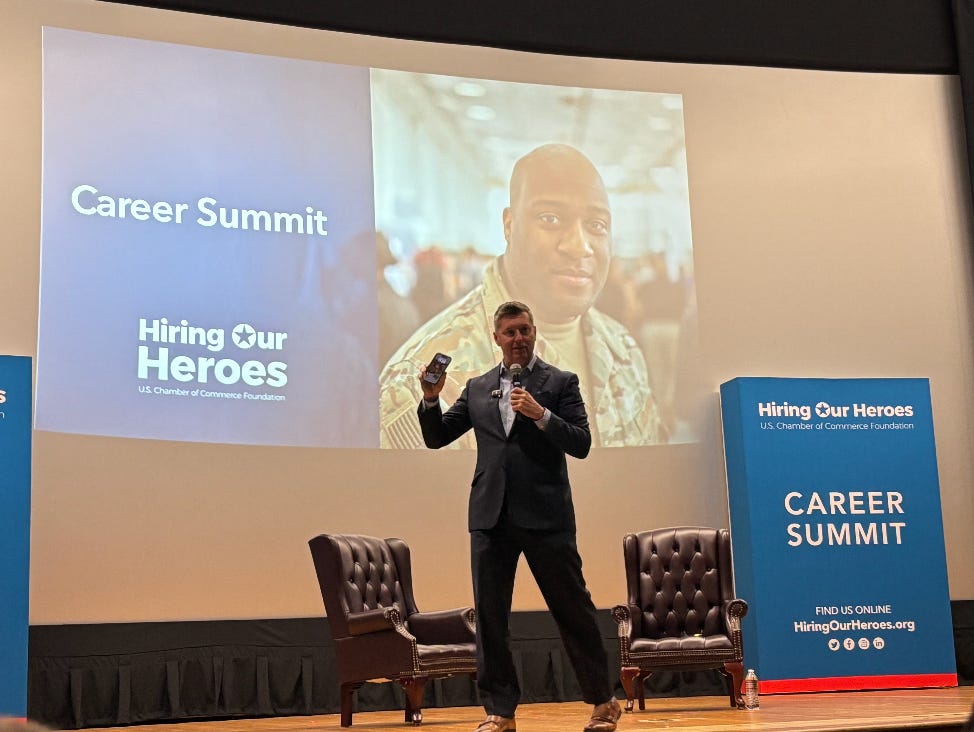
I gave them every piece of advice I had—except for the most personal one.
I didn’t tell them that I, too, had been broke, unemployed, and floundering after taking off the uniform. That I knew exactly how it felt to sit at the kitchen table, looking at a dwindling bank balance, paying student loans, and calculating how many PB&J sandwiches you can make with what’s left. I’m embarrassed to talk about it today. It’s easier to write about it than to talk about it.
Today, because of the efforts of Tim Walz, Jim Webb, and so many other great Americans, veteran unemployment sits around 3% which is below the national average (~4 %). However, younger veterans continue to face real challenges. In May 2025, veterans aged 18–24 had an unemployment rate of 9.3%, slightly higher than their non-veteran peers. Military spouses face even steeper barriers. While the overall adult unemployment rate is about 4%, military spouses report an unemployment rate of around 21%.
I talk a lot about moral courage. About how our leaders often lack it. But last week, as I stood there encouraging these troops to be open about their struggles, it hit me in the gut: I wasn’t practicing what I preached.
So here’s me rectifying that.
3 Lessons from My Unemployment
Whether you’re a veteran or just someone in between jobs (or lost in general), these lessons apply to you:
1. Transitions Are Hard. You’re Not In This Alone.
Every year, 200,000 servicemembers & military spouses transition out. It’s a churn that doesn’t stop. Hiring Our Heroes hosts over 80 events a year to help them. My advice: Don’t fall through the cracks. Take ownership of your journey. Don’t necessarily jump at the first job just because it’s there or the highest paying. Be strategic about what you really want. The right job in the right industry, at the right time, can change your life. Have the patience to wait for it. And actively seek it out.
2. Your Network Is Your Net Worth.
Take out your phone. Right now. Open LinkedIn. Connect with me. I mean it—I’ll accept your invite (even if you don’t write a note). And if I can’t help directly, I’ll introduce you to someone who can. Relationships matter. A Zoom call is better than a phone call. An in-person meeting is better than a Zoom. Make the effort. Be social. Cultivate relationships. People are willing to help if you ask. But ask for advice, not a job. If you ask for a job, you’ll get advice. If you ask for advice, you’re more likely to get a job.
3. Plan Your Work and Work Your Plan.
Set weekly goals. Maybe it’s five new connections a week. Prepare your Ethos (your credibility), your Logos (your data, your argument), and your Pathos (describe your passion). That’s Aristotle’s formula, and it still works over 2,000 years later. It’s what I teach my students at Wharton. You have to make people care. You have to make them believe. And you have to keep going after hearing “No” a hundred times.
People tell me “No” every day. (in business, dating, in life generally, and that’s ok). That’s life. What matters is finding the “Yes” that aligns with your purpose.
They say a smart person learns from their own mistakes, but a wise person learns from someone else’s. So be wise. Learn from me.
Don’t be too proud to ask for help. Be raw. Be authentic. Pay it forward. Be prepared. And believe that tomorrow will be better—because it’s in your power to make it so.
— Patrick
The Honorable Patrick J. Murphy is a Wharton lecturer, Vetrepreneur, and the 32nd Army Under Secretary after earning the Bronze Star for service in Baghdad, Iraq as an All-American with the 82nd Airborne Division—@PatrickMurphyPA on Instagram and Twitter.
Patrick, thank you for your honesty and shedding a light on a subject we (the public) never hear. I have watched you tirelessly support and nurture our Veterans. In all you do, there is always an underlying message, help others. Those men and women who were in your classroom will never forget your commitment and lesson to them and it will be a message they will be able to pass on. Thank you again for your service and dedication to our Veterans.
Patrick- I have to say, I was looking at the long list of emails in my inbox and thinking "I need to unsubscribe from a lot of these." I looked at your email and thought "I don't even know who this guy is." Then I decided to open the email before deciding. I'm glad I did. Your history is a powerful indicator of your character, and I appreciated your story....and will continue to read your columns.